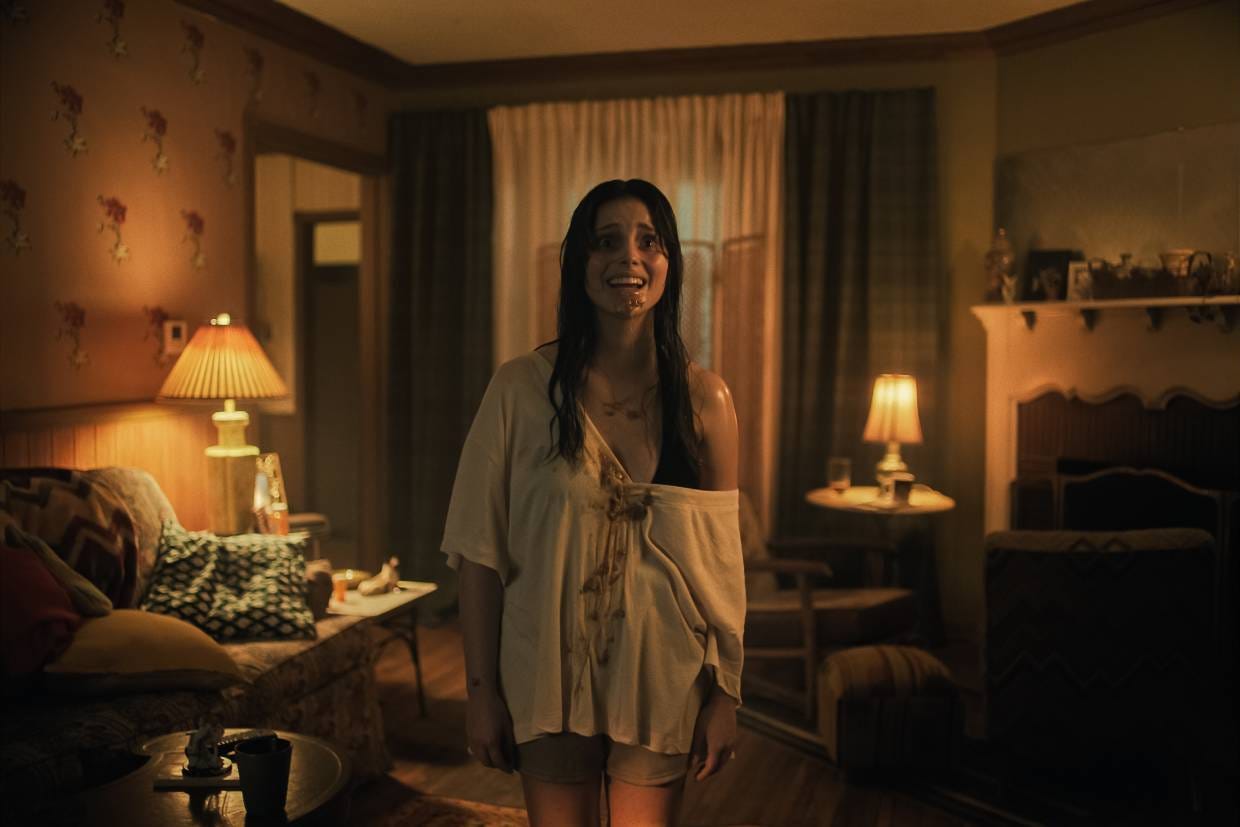

Curry Barker’s supernatural horror thriller is often more interesting to think about than it is to watch. While the film occasionally suffers from repetition and a sluggish pace, it remains fascinating as a reflection of generational attitudes toward relationships, guilt, and personal responsibility.

The premise follows Bear, a socially awkward twenty-something who uses a magical wish-granting artifact to make his longtime crush, Nikki, fall hopelessly in love with him. In a film made by and for an earlier generation, this setup might have played out as a straightforward cautionary comedy: the protagonist gets exactly what he wants, quickly realizes the fantasy is flawed, and learns a valuable lesson by the end. Barker’s film takes a different approach. Rather than reveling in his newfound success, Bear is immediately overwhelmed by guilt and anxiety. From the moment the wish comes true, he is consumed by fear that he has done something terrible.
What makes Bear intriguing in theory is also what makes him frustrating in practice. He spends much of the film trapped in a state of paralysis, worrying about the consequences of his actions while failing to take meaningful steps to correct them. Even as the situation spirals out of control, he delays pursuing the obvious solution. His guilt never prevents him from benefiting from the circumstances he created; it merely robs him of any enjoyment. He repeatedly convinces himself that he has no choice but to comply with Nikki’s increasingly dangerous demands, yet neither the audience nor the character himself seems fully convinced by that excuse.
Unfortunately, the writing and performance struggle to make Bear a compelling central figure. Michael Johnston gives a committed performance, but the character remains difficult to sympathize with, relate to, or even find particularly interesting. From the opening scenes, spending time with Bear feels more exhausting than engaging, despite the fact that he comes across as more likable than his friend Ian, played by Cooper Tomlinson.
The film truly comes alive whenever Inde Navarrette appears on screen. As Nikki—Bear’s childhood friend, co-worker, and the object of his obsession—Navarrette delivers a remarkable performance that elevates nearly every scene she inhabits. Even before the supernatural elements take hold, she displays an effortless screen presence and emotional authenticity. Once the story demands that she navigate the increasingly disturbing realities of her character’s situation, she becomes impossible to look away from. Her work here ranks among the strongest performances of the year, and it would be surprising if she does not receive significant critical recognition.
Nikki’s predicament is both more horrifying and more restrictive than Bear’s, yet Navarrette continuously finds new shades within the role. She keeps the audience invested by revealing different emotional textures in every scene, creating a palpable sense of entrapment while maintaining an element of unpredictability. We are constantly left wondering how Nikki will react to each new escalation.
One might wonder whether the film would have benefited from spending more time from Nikki’s perspective. While that approach could have deepened the emotional impact, it may also have shifted the film into territory reminiscent of other stories centered on stolen autonomy. Instead, Barker largely keeps us at a distance from Nikki’s inner experience, granting access to her true feelings only sparingly. When those moments arrive, they are devastating.
The film’s most effective sequences—particularly its graphic violence and body-horror imagery—reinforce its central themes of lost agency, violated autonomy, and the horror of being trapped within circumstances beyond one’s control. These scenes carry genuine emotional weight and give the film a thematic focus that many contemporary horror films strive for but rarely achieve.
Obsession is not entirely successful. Its pacing drags, its protagonist is difficult to invest in, and some of its ideas feel more compelling than their execution. Yet the film lingers in the mind long after it ends. Thanks largely to Navarrette’s extraordinary performance and the unsettling questions it raises about desire, control, and consent, Obsession proves far more memorable than many recent horror films tackling similarly ambitious themes.
Short Review:
Obsession is often more compelling as an idea than as a viewing experience, but its exploration of guilt, autonomy, and obsession gives it surprising depth. While the film is held back by an intentionally frustrating protagonist and uneven pacing, Inde Navarrette delivers a standout performance that transforms the material into something genuinely memorable. Her work alone makes the film worth watching.